Visuals
The opportunity zones
A strategic economic development plan for a nationally ranked micropolitan economy — shifting Wooster from transactional deal-making toward placemaking, talent attraction, and the levers uniquely within the city's control.
BusinessFlare® prepared the City of Wooster's Economic Development Strategic Plan (EDSP), a two-part engagement pairing a Local Economic Drivers and Conditions Report with a forward strategy organized around seven sequenced goals, five opportunity-site zones, and a full implementation roadmap. Rather than replacing the industrial-recruitment successes that earned the Wooster MSA a #7 national ranking for Economic Strength and #1 in Ohio, the plan focuses on quality of life and organic business growth — the tools uniquely within the city's control.
The approach evaluated Wooster against the six economic development drivers — Land, Labor, Markets, Capital, Regulations, and Quality of Life — using market data (ESRI, CoStar, Placer.ai, LEHD) alongside stakeholder interviews. The diagnosis: Wooster is a mass employment magnet importing labor into the county, but faces constrained land, gaps in young-talent retention, conventional zoning, and missing 'third places' — pointing to a strategic, placemaking-led next phase of growth.
Wooster's economic engine is already strong — the city holds 41% of Wayne County employment, 44% of its wages, and hosts at least 8,000 more jobs than it has working adults — but the next phase of growth hinges on things incentives can't buy. In a talent-driven market where workers choose place first and jobs second, Wooster must compete on aesthetics, housing choice, entrepreneurship, and quality of life. The plan reframes economic development from transactional deal-making to strategic, balanced growth.
Seven sequenced goals, five opportunity zones, and a partner-driven implementation model.
Wooster's existing businesses are the foundation of local employment, the tax base, and organic growth. The plan builds relationship-driven retention through a business visitation program, coordinated BRE visits with WEDC, and small-business support delivered with the Chamber and Main Street Wooster.
Wooster sits on the cusp of the northeast Ohio market and is often overlooked in regional analytics. The plan develops a real brand strategy and improves community first impressions at gateways and high-visibility destinations.
With labor gaps in healthcare, retail, and hospitality and a chance to retain young talent, the plan positions Wooster to attract workers and become a hub for entrepreneurship, innovation, and creative industries — leveraging anchors like Wayne Center for the Arts, the library, Local Roots, and area food ventures.
The city's most direct levers are its land assets and regulations. The plan uses acquisition, disposition, and publicly owned land — with the Wayne County Land Bank — to assemble parcels and target sectors, while modernizing conventional zoning to enable mixed-use and missing-middle housing.
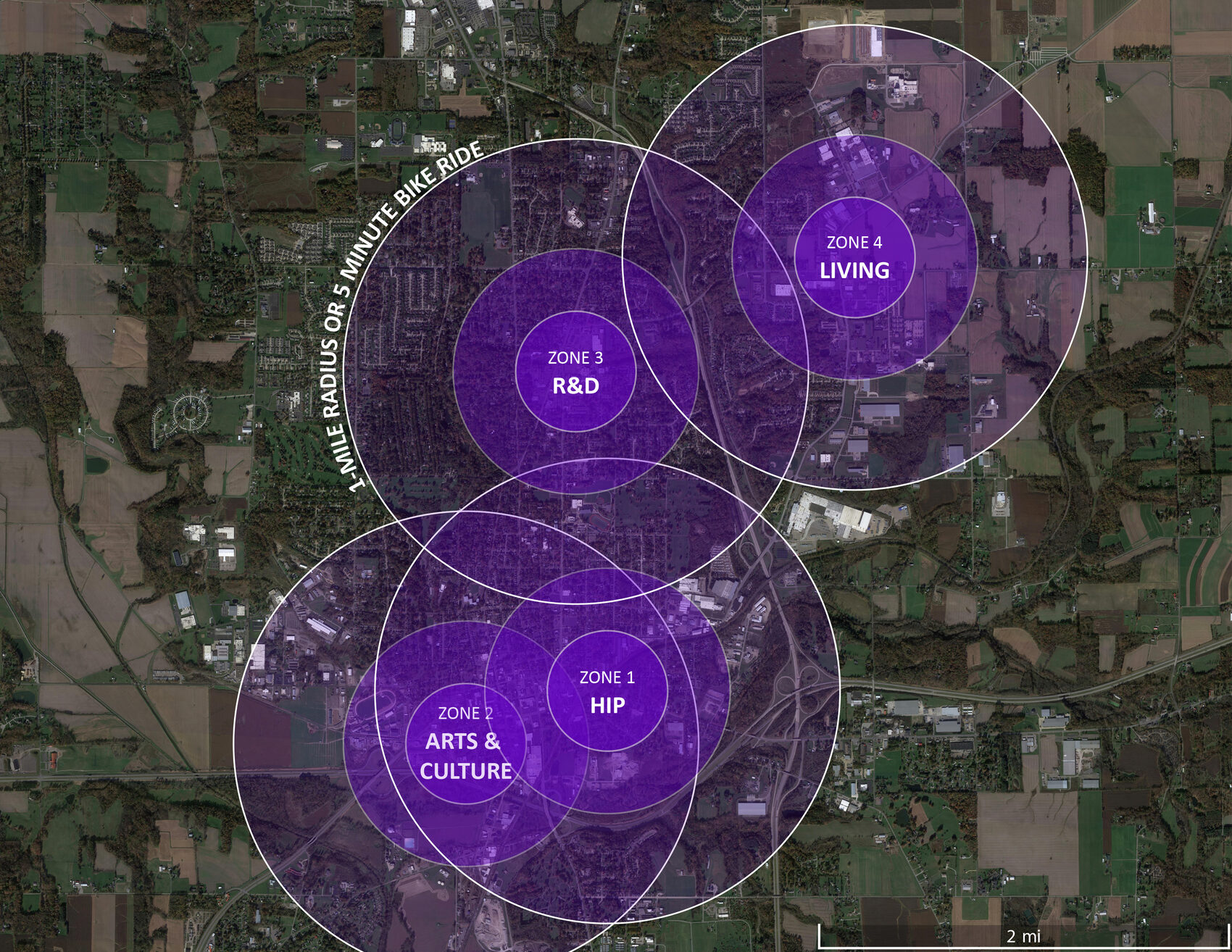
The plan identifies five opportunity zones — the Arts & Culture District, an entertainment gateway, an R&D / innovation node, a hospital-anchored district, and a live/work living zone. Each is a gateway or high-spending node where policy change and public investment are concentrated, with concrete concepts and before/after visions.
Implementation depends on collaboration. The plan organizes activity areas into cross-organization teams, maps lead-versus-partner roles across the City, WEDC, Wooster Growth Corporation, Main Street, the Land Bank, TeamNEO, and JobsOhio, and catalogs each partner's tools — backed by an Implementation Matrix and funding appendix.